Ashoka-Environmental Defense Fund Climate Corps Blogs
Building the Workforce for Climate Action: Highlights from the Climate Workforce Summit 2025
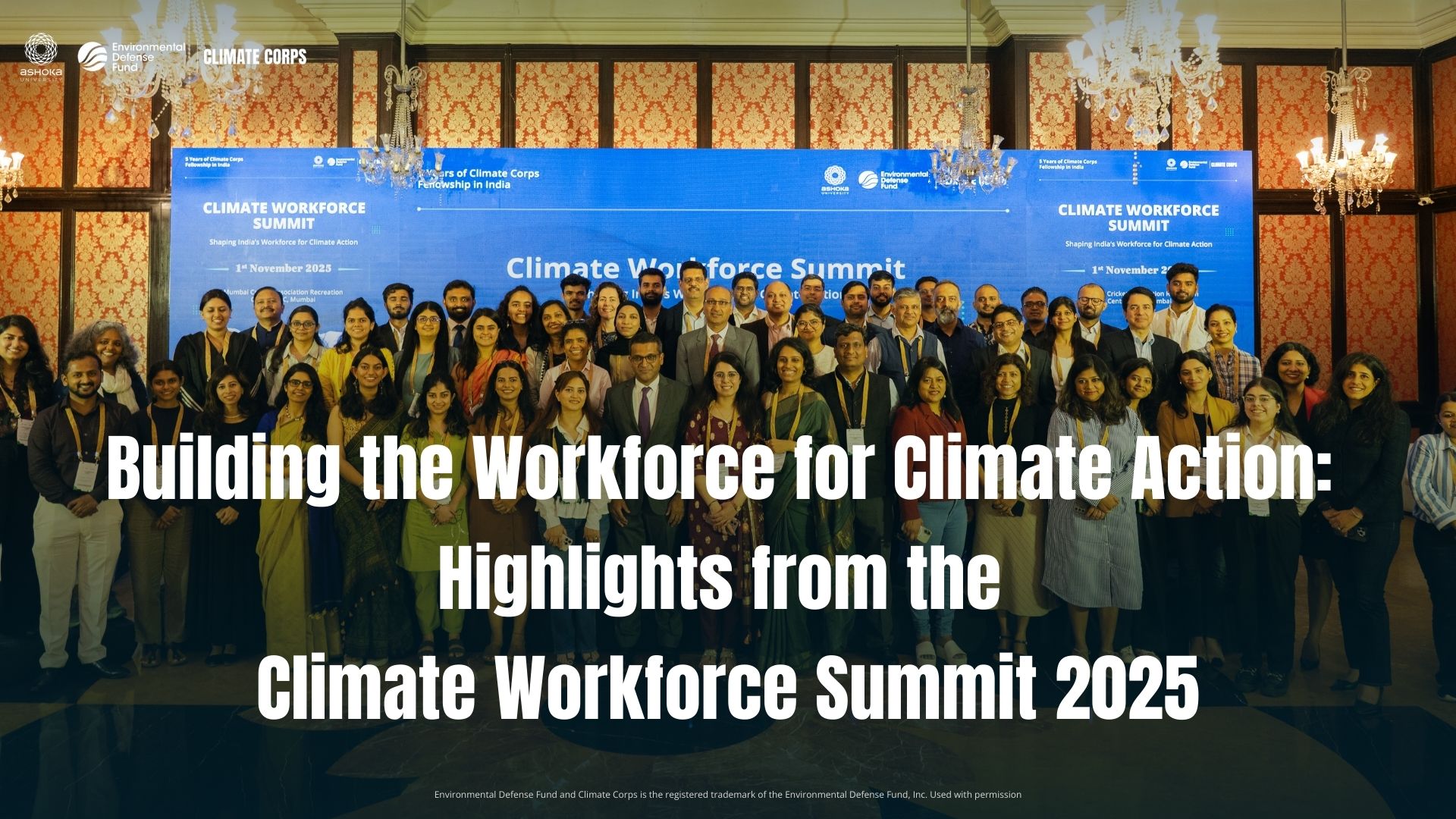
As the world races to meet its climate commitments, the question of who will power this transition has never been more urgent. On 1 November 2025, leaders from business, finance, policy, and academia gathered in Mumbai for the Climate Workforce Summit, hosted by Ashoka University and Environmental Defense Fund (EDF), to mark five years of the Climate Corps Fellowship in India.
The milestone event was more than a celebration — it was a collective reflection on how India can build a skilled, future-ready workforce capable of driving the country’s sustainability ambitions. About 150 participants, including sustainability heads, HR leaders, policy-makers, entrepreneurs, and fellows from the Climate Corps network, joined the discussions, bridging ideas across sectors to turn climate intent into climate talent.
Why this summit, why now
When the Climate Corps Fellowship was launched in India in 2021, it began with a simple premise — that capital and technology alone cannot solve the climate crisis; the missing piece is people. Five years later, that hypothesis rings true across every boardroom and government office.
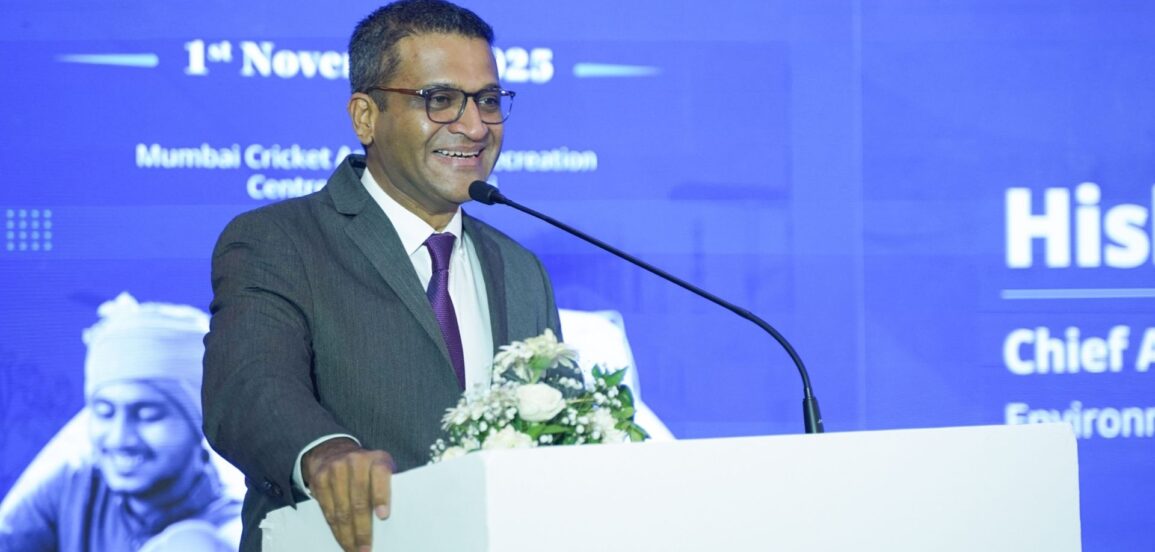
Hisham Mundol, Chief Advisor, India - Environmental Defense Fund
In his opening address, Hisham Mundol, Chief Advisor, India at EDF, captured this shift succinctly, “The future of work and the future of the planet are now the same thing.” He reminded the audience that the bottleneck in climate action is no longer intent, but talent. As organisations across sectors embrace net-zero targets, they are realising that sustainability cannot remain a vertical staffed by specialists -- it must become “a horizontal muscle” that every function flexes, from operations and finance to HR and procurement.
Drawing parallels to India’s digital revolution two decades ago, Mundol called for a similar green-skilling revolution that retools the workforce to make every job greener. “Finance will power India’s green transition. Technology will enable it. Policy will steer it. But skilled, motivated, climate-ready people will actually deliver it,” he said.
A gathering of changemakers
The Summit brought together leaders who have been instrumental in shaping India’s climate and sustainability landscape. Among them were Amit Chandra, Chairperson, Bain Capital India and Trustee, Ashoka University; Rajiv Anand, MD & CEO, IndusInd Bank; Dr. Kiran Somvanshi, journalist and visiting faculty at TISS; Dr. Nipun Sharma, CEO, TeamLease Degree Apprenticeship; a representative from the Skill Council for Green Jobs (SCGJ); and Ms. Naghma Mulla, CEO, EdelGive Foundation. The event also featured speakers from the session “Beyond the Compliance: The Real Story of Corporate Climate Transition,” including Anjalli Ravi Kumar, Chief Sustainability Officer, Eternal (Zomato, Blinkit & Hyperpure); Manish Kumar Ashok, Head – ESG & CSR, ICICI Bank; Prabodha Acharya, Group Chief Sustainability Officer, JSW Group; and Ram Vaidyanathan, AVP & Head – Environmental Sustainability, Godrej Industries — alongside corporate sustainability leaders such as Monika Shrivastava, Head of Sustainability at JSW Cement; Vivek Adhia, Senior Leader – Climate & Sustainability at BCG; Amrit Om Nayak, Co-founder & CEO, Indra Water; Priya Shah, Founder, Theia Ventures; and Mairu Gupta, Founder & CEO, Antkind.
The day began with a warm welcome from Dr Sanjana ND, a 2024 Climate Corps Fellow now working with government think tank NITI Aayog, who set the tone by reminding the audience that “this Summit is both a strategy session and a family reunion.”
Session Highlights
1. Welcome Address: From capital to capability — building the human engine of India’s green growth
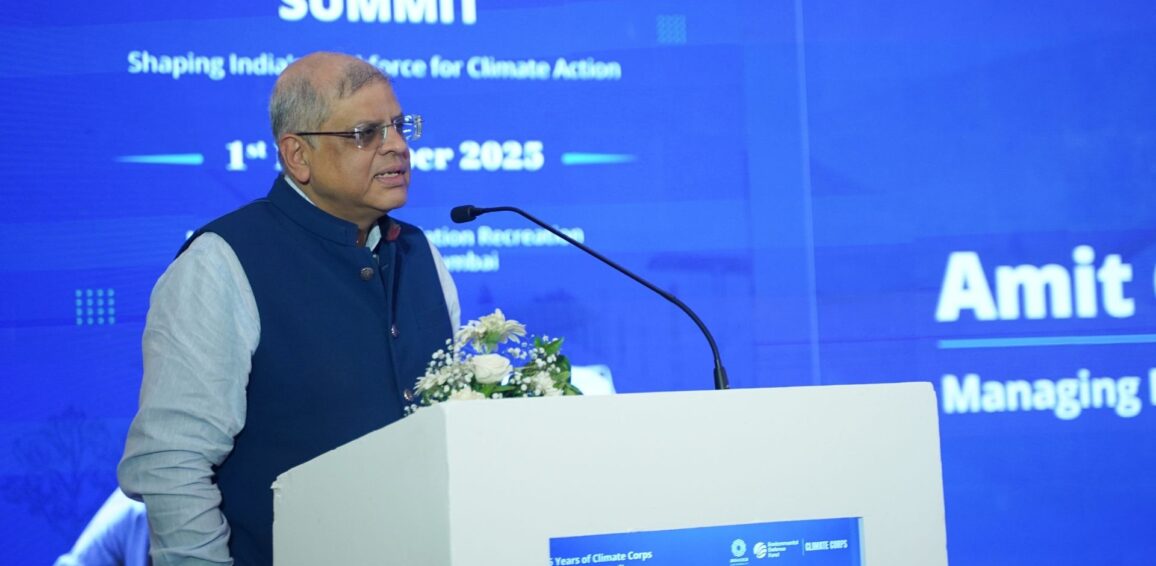
Amit Chandra, Managing Director - Bain Capital
Amit Chandra, in his welcome address, connected the dots between India’s climate realities and its economic imperatives. Drawing from his field visits in flood-hit Punjab and Marathwada, he noted how extreme weather events have become frequent -- “what used to be a six-sigma event now happens every few years.”
He emphasised that sustainability can no longer be confined to boardrooms; it must shape fiscal policy and individual behaviour alike. “The legacy of our generation will depend on how urgently and imaginatively we act,” he said, urging India’s corporate and public leaders to embed climate resilience into both investment decisions and governance frameworks.
Chandra’s message was one of cautious optimism. “Every major challenge that humanity has faced has promised bleakness, but it’s always people — individuals — who light the first lamp,” he said. “The fellows of Climate Corps are that light.”
2. Fireside Chat: How regulation is reshaping India’s climate workforce
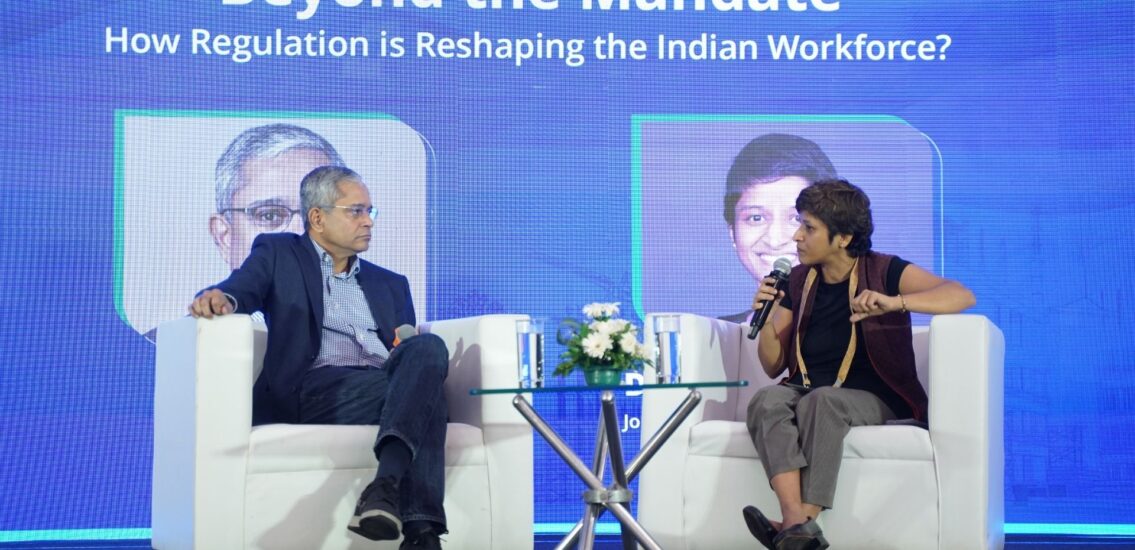
Rajiv Anand, CEO - IndusInd Bank (left) and Dr. Kiran Somvanshi, Journalist, Writer and Visiting Professor (right)
Moderated by Dr. Kiran Somvanshi, the conversation between Rajiv Anand, CEO of IndusInd Bank, and Somvanshi explored how India’s evolving climate regulations are redefining risk, finance, and employment.
Anand explained that Indian banks now embed climate risk into credit assessments, especially for term loans, and perform environmental due diligence before financing projects. Transition finance, he noted, represents both a challenge and an opportunity as corporate India shifts toward renewable energy, EVs, and green infrastructure.
While regulatory frameworks such as SEBI’s BRSR and the RBI’s climate-risk task forces are essential, Anand cautioned that consistent taxonomy and disclosure standards are key to preventing greenwashing. He acknowledged that smaller firms still face the cost of compliance but predicted that, over time, economic logic would drive the shift: “Moving from thermal to renewables isn’t just the right thing to do — it’s also cheaper.”
On workforce implications, Anand struck an encouraging note: “Jobs will evolve, not disappear. Just as ATMs increased tellers, AI and the climate transition will create new roles — in sustainability analytics, risk pricing, and green finance.”
3. Panel: Skilling India’s blue-collar workforce for the green transition
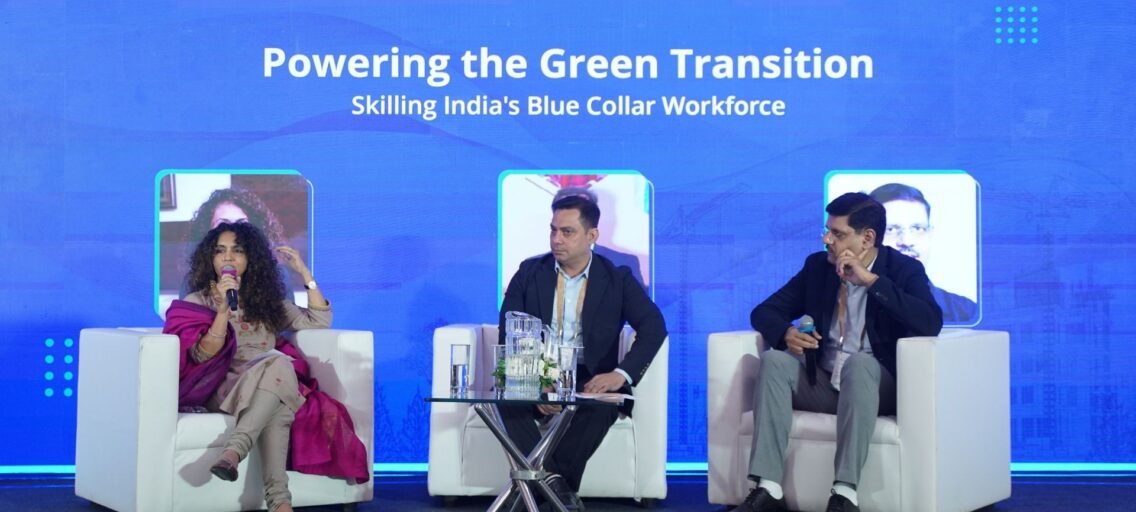
Left to Right: Naghma Mulla, CEO - Edelgive Foundation, Arpit Sharma, CEO - Skill Council for Green Jobs, and Dr. Nipun Sharma, CEO - TeamLease Degree Apprenticeship
The discussion on India’s blue-collar and informal workforce, moderated by Naghma Mulla (EdelGive Foundation), brought the conversation down to the ground. Arpit Sharma (Skill Council for Green Jobs) and Dr. Nipun Sharma (TeamLease Degree Apprenticeship) shared a practical view of India’s skilling landscape and the opportunity ahead.
Arpit Sharma outlined the scale of workforce demand linked to India’s renewable targets, noting that the country has already installed more than 250 GW of clean energy capacity on the path to 500 GW by 2030. Rooftop solar alone, he said, is expected to create over 900,000 jobs. He highlighted SCGJ’s efforts to build capacity in emerging areas such as green hydrogen, where the sector remains talent-starved. SCGJ has already developed around 12 job-role qualifications and trained over 5,000 people, working with training partners such as Tata Power Skill Development Institute (TPSDI) and Avaada’s centres of excellence for hands-on industry training. However, he cautioned that in advanced segments like green hydrogen, floating solar and large wind turbines, “the lack of skilled manpower and frequent policy shifts deter industry investment.”
Dr. Nipun Sharma spoke about the critical role of apprenticeships in building a job-ready green workforce. Only around 0.27% of India’s workforce participates in apprenticeships, he noted, compared to 3-4% in countries like the UK and Germany. He pointed to government schemes such as the National Apprenticeship Promotion Scheme (NAPS) and National Apprenticeship Training Scheme (NATS), which offer direct-benefit transfers to young people in training, but emphasised the need to make vocational education aspirational and align pathways to industry demand.
Both speakers underscored the risk of widening inequality if the transition does not deliberately include women. Without targeted investments in training and placement, they warned, women in self-help groups and rural enterprises may be left behind in India’s green jobs transition.
4. Panel on Beyond Compliance
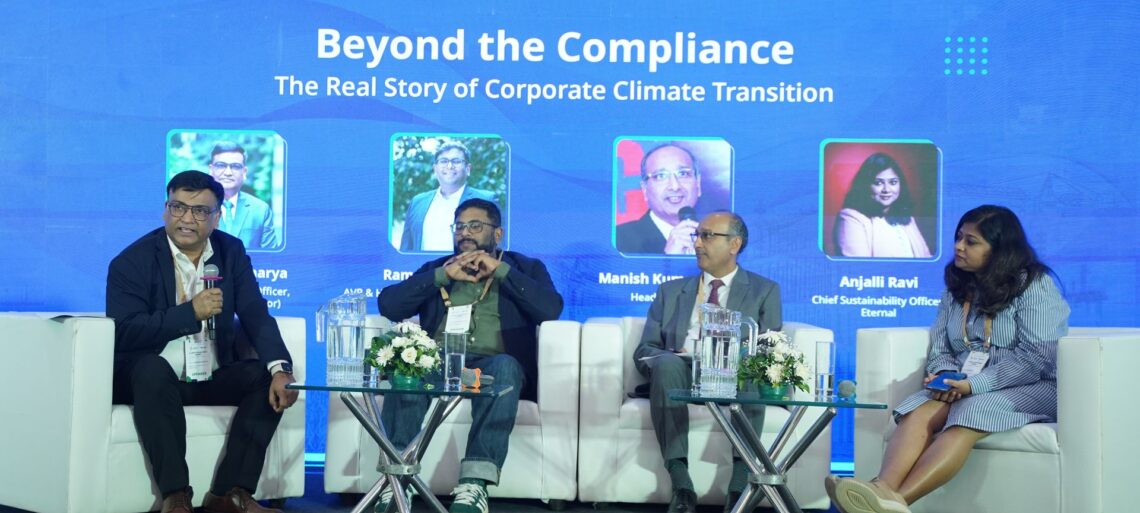
Left to Right: Prabodha Acharya, Chief Sustainability Officer - JSW Group, Ram Vaithyanathan, AVP & Head of Environmental Sustainability - Godrej, Manish Kumar Ashok, Head, ESG & CSR - ICICI Bank, and Anjalli Ravi Kumar, Chief Sustainability Officer - Eternal
The Beyond Compliance panel — co-created with AXA Climate — explored how companies can move from viewing ESG as a reporting exercise to embedding sustainability into core business strategy. Moderated by Prabodha Acharya (Chief Sustainability Officer, JSW Group), the conversation featured Ram Vaithyanathan (AVP & Head of Environmental Sustainability, Godrej), Manish Kumar Ashok (Head, ESG & CSR, ICICI Bank) and Anjalli Ravi Kumar (Chief Sustainability Officer, Eternal).
The speakers reflected on what prompted internal shifts toward climate action within their organisations. At ICICI Bank, early momentum came from investor expectations and regulatory drivers, with COVID-19 acting as a turning point for redefining the idea of a sustainable financial institution. At Godrej, promoter-led vision and long-standing commitments under its Good & Green strategy enabled faster alignment across the organisation. For Zomato, a culture of experimentation — including plastic-neutral delivery efforts and early EV pilots with delivery partners — helped reimagine climate action inside consumer-facing operations.
A core theme was decentralising sustainability so it doesn’t sit only with ESG teams. Vaithyanathan shared that at Godrej, leadership KPIs now include people and planet goals, with around 30% of remuneration linked to at least one of these outcomes, enabling accountability at every level.
The panel also reframed sustainability as an opportunity, not an obligation. Whether through access to new investor classes, brand trust, or efficiency-driven savings, each organisation found business value in going beyond minimum compliance. As Acharya noted, companies accelerate when sustainability becomes a driver of strategy and innovation rather than a cost line on a spreadsheet. One of the core insights emerging across panels was that the CSO of the future is every business leader.
5. #OpenDoorClimate LIVE
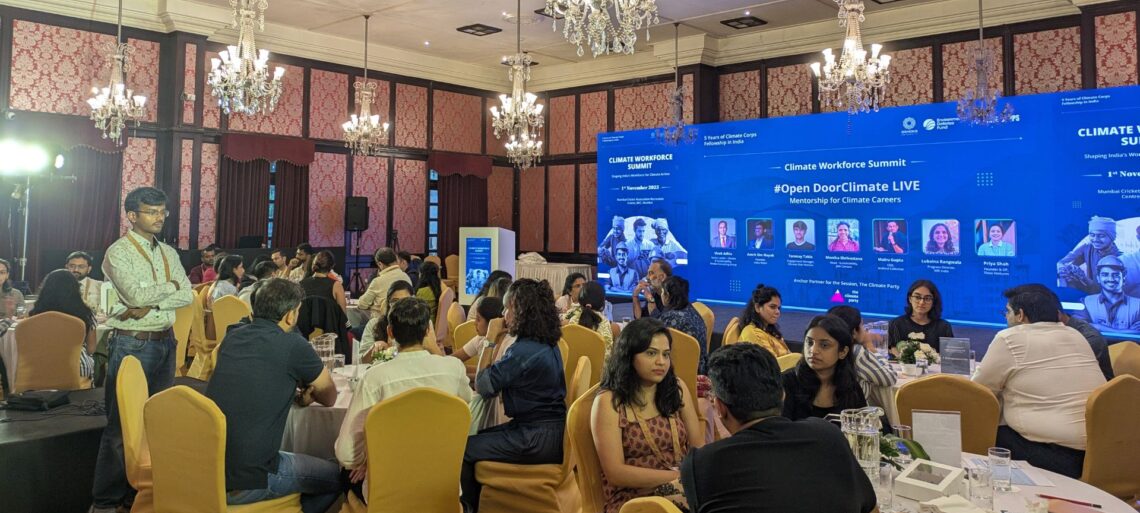
#OpenDoorClimate LIVE
One of the most anticipated segments of the Summit was #OpenDoorClimate LIVE, designed as an open, honest space for early-career professionals to understand what it truly takes to build a future in climate. The session welcomed participants who had signed up in advance, with others joining in by connecting with the Climate Party team.
The purpose of the session was clear from the outset:
“All of you are here because you’re curious about making a career in climate — and we wanted to enable that.”
The organisers — the Climate Corps Fellowship team and The Climate Party — set the context by emphasising the need for spaces where people can learn from each other, ask difficult questions, and understand the real challenges and motivations behind climate work. As Climate Party’s Mumbai leads shared, the session was designed in response to recurring feedback from their community: people need a place to meet like-minded peers, map opportunities, and learn how to navigate the sector.
To bring this vision alive, seven experts from seven distinct areas of climate work were invited to mentor participants across two rotating discussion rounds. Each table represented a job pathway — consulting, policy, startups, marketing and communications, urban resilience, investment, and corporate sustainability — mirroring the actual landscape of climate jobs in India. Participants were allocated tables based on their earlier preferences, ensuring they engaged with mentors aligned to their interests. Each group spent 30 minutes with a mentor, followed by a switch to a second table for deeper exploration.
As one mentor remarked,
“It’s not a pivot — it’s an expansion. What you did before will inform what you’ll do in climate.”
The session closed with mentors sharing final reflections from their conversations: the need for clarity, the hunger for meaningful work, and the importance of cultivating networks. Participants left with not just answers, but direction — and a sense that they’re not navigating the climate space alone.
Humanising climate work
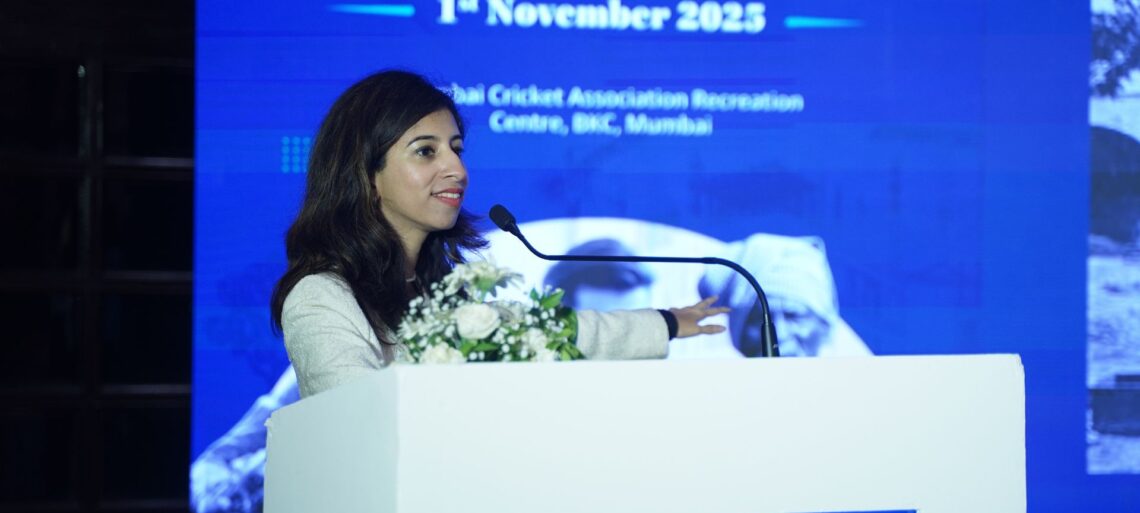
Dr. Sanjena ND, Climate Corps Fellow 2024
One of the Summit’s most compelling segments was the Climate Corps Showcase, where current fellows and alumni shared their project journeys — from designing decarbonisation strategies to advancing ESG reporting in manufacturing firms. Their stories revealed the human dimension of climate work: collaboration, experimentation, and persistence in the face of complex systems.
“The fellowship isn’t just about technical solutions; it’s about systems change,” said a fellow from the 2024 cohort. “You learn to work within organisations — to make sustainability part of everyday decision-making.”
Initiatives that made the event special
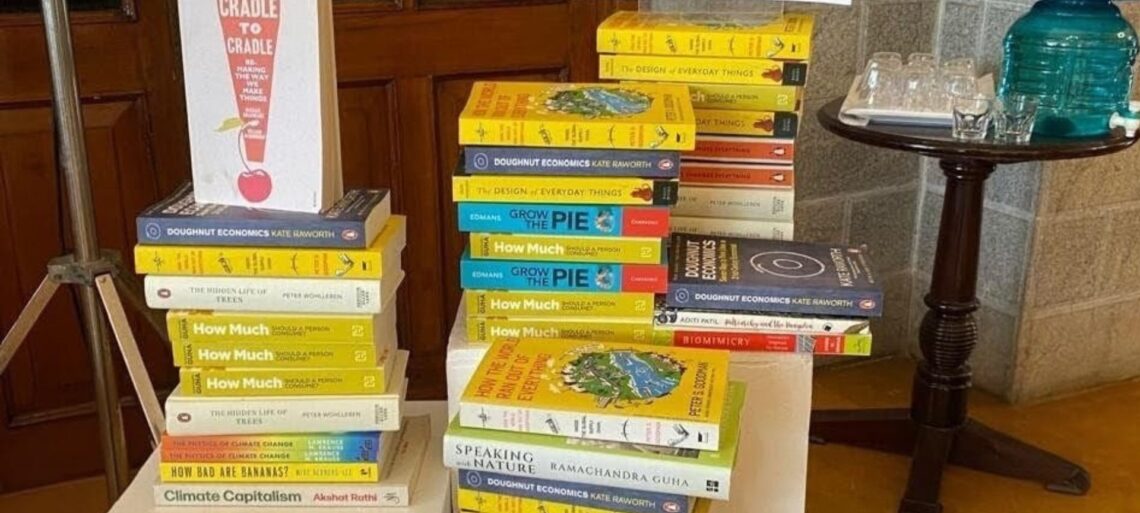
Pre-Loved Books Exchange
In keeping with the spirit of sustainability, the Summit consciously minimised its footprint through a series of thoughtful gestures:
- No plastic bottles or disposable cups: The event partnered with a local supplier for reusable cutlery.
- Speaker gifts were replaced with purpose: Instead of traditional souvenirs, the organisers made a donation to Waste Warriors, supporting their waste bank initiative in Uttarakhand to promote decentralised waste management.
- Pre-loved book exchange: Attendees were invited to exchange books they loved, creating a “climate bookshelf” at the registration desk.
- Solutions Wall: A participatory space for intentional, reciprocal networking among participants, where participants shared what they could offer to others in the climate space as well as where they sought support
These small but significant initiatives reflected the event’s ethos: sustainability practised, not just preached.
Looking ahead: From celebration to commitment
As the summit drew to a close, the mood was one of reflection and renewed resolve. The day was celebrated not as an ending, but as the beginning of continued collaboration, learning and action.
Charvie (Mahindra Automotive and Farm Equipment) closed the day by returning to a line from Emily Dickinson — “Not knowing when the dawn will come, I open every door” — capturing the spirit of the conversations, mentorship sessions and spontaneous hallway exchanges that shaped the day’s momentum.
Taking the mic, Hisham Mundol thanked everyone, emphasizing that the real success of the summit lies in what participants build beyond the room: “If there’s one point of connection that you can build on, build on it and then build another — and that’s how you make a movement.” He left the audience with a reminder that sustainability requires stamina, not just slogans.
Thank you for being part of the Climate Workforce Summit.