Carbon dioxide is invisible, and for most of industrial history, it was also free. A factory could pump it into the atmosphere without paying a cent for the damage it caused. Economists have a name for this kind of problem: an externality. The cost of climate change gets pushed onto everyone else, while the person doing the polluting pays nothing.
Carbon pricing is an attempt to fix that. The idea is simple. If pollution has a real cost to society, then someone should have to pay for it. Once that cost shows up on a balance sheet, businesses start making different decisions. Cheap, dirty energy stops looking so cheap. Cleaner alternatives start to look more competitive. The market begins to shift on its own, without anyone having to mandate exactly how each company should cut its emissions.
That last part matters a lot. Governments could simply tell every factory how much to reduce its emissions by. But regulators rarely know which companies can cut carbon cheaply and which ones can’t. A price signal solves this problem elegantly. It lets each business figure out for itself whether it’s cheaper to cut emissions or to pay for them.
Two Ways to Set a Price
There are two main tools for putting a price on carbon: taxes and markets. They both aim for the same outcome but get there differently.
A carbon tax is the more direct approach. A government sets a fixed price per ton of carbon dioxide and charges companies that amount for what they emit. It works a lot like a sales tax. The price is known in advance, which makes it predictable for businesses to plan around. What isn’t guaranteed is the actual amount of emissions reduced. If the tax is set too low, companies might just pay it and keep polluting.
A carbon market, often called cap and trade, flips this around. Instead of setting a price and letting emissions float, the government sets a hard limit on total emissions, called a cap, and lets the price float. Companies are given or sold a fixed number of permits, each one allowing them to emit one ton of carbon dioxide. If a company can cut its emissions cheaply, it can sell its spare permits to a company that finds cutting emissions expensive. The company that struggles to reduce emissions buys extra permits instead. While governments run compliance carbon markets, there is also a voluntary carbon market. Here, companies or individuals can buy carbon credits to support projects that reduce or remove emissions, such as reforestation or renewable energy. Unlike an emissions trading system, participation is voluntary, and buying a credit does not replace the legal obligation to reduce emissions under a government carbon pricing scheme.
This is where the efficiency argument comes in, and it’s worth sitting with for a moment. Under a market system, the cheapest reductions happen first. A power plant that can switch to cleaner fuel for ten dollars a ton will do it and sell its unused permits. A steel plant that would need to spend two hundred dollars a ton to cut emissions will buy permits instead, at least for now. Emissions still fall, and the cap still gets hit, but the pain of getting there is distributed to whoever can bear it most cheaply. That’s the classic economic case for markets: they find the lowest cost path to a goal, as long as the market itself is well designed and genuinely competitive.
Of course, this depends on believing that markets are actually efficient in practice, not just in theory. Real carbon markets have to deal with things like free allowances handed out to politically important industries, price volatility, and the risk that permits get too cheap to actually change behavior. These are practical design challenges, and different markets around the world have handled them with varying degrees of success.
How This Plays Out Around the World
Carbon pricing looks very different depending on where you are. Some regions cover most of their economy under a single carbon price. Others cover a narrow slice of it. Some set prices high enough to really bite. Others keep prices low enough that they barely register.
Two things are therefore useful to compare across different carbon pricing systems: how much of a region’s emissions are actually covered by the price, and how high that price actually is.
Chart 1: Price per tonne of CO2 by region, % of global coverage (World Bank, 2026)
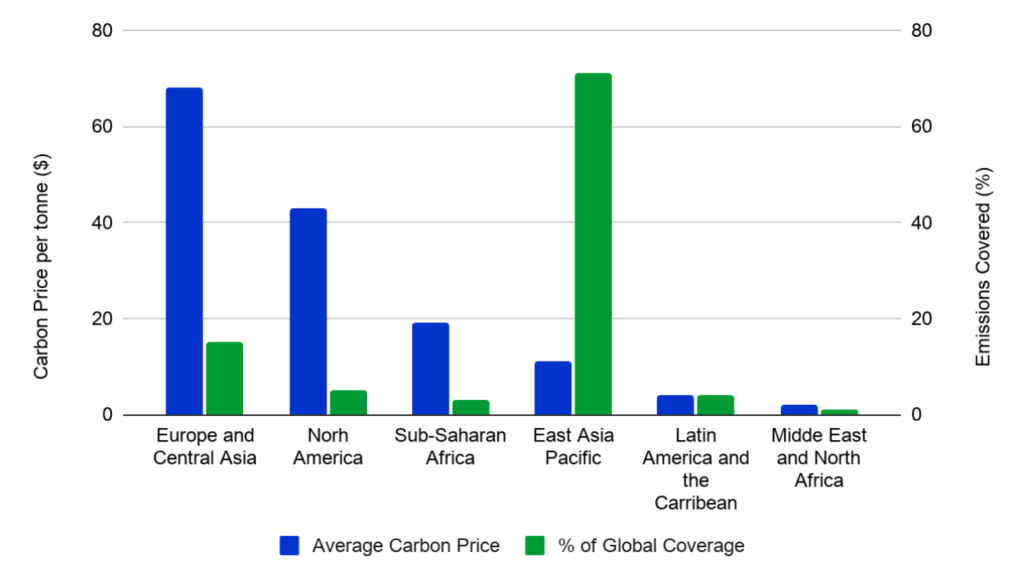
These two numbers together tell you much more than either one alone. A high price that only covers a small slice of the economy might sound aggressive but leave most emissions untouched. A low price that covers nearly everything might sound weak but still shift decisions across an entire economy. Neither number by itself tells you how effective a carbon pricing system actually is.
Why This Matters
As more countries and regions experiment with their own approaches, these comparisons will only become more important. Understanding the basic mechanics, price versus coverage, tax versus market, is the first step to understanding whether any given carbon pricing system is really built to work.
But the promise of carbon pricing goes beyond just comparing systems. It’s what happens once the price becomes normal, just another line item like electricity or wages, instead of a special case for a few industries. Think about what a stock market actually does. Its main job isn’t just to track a number for investors to watch. It lets companies raise capital. A strong share price gives a business access to cheaper loans, new investors, and room to grow. A weak one shuts those doors. Carbon pricing can work the same way. Once pollution has a real, visible cost, projects that cut emissions stop being just good intentions and start being something that can raise money on their own merit. A reforestation project can generate carbon credits, sell them, and use that revenue to attract financing, the same way a company uses its stock to raise capital. This is already happening through carbon finance, where the promise of future carbon credits helps fund projects today.
A heavy polluter faces the opposite problem. Markets are always trying to price in the future, not just the present. A company loaded with debt or facing a wave of new competition doesn’t need to wait for earnings to actually fall before its valuation suffers, investors price in the risk today. A strengthening carbon price works the same way. As the price of pollution rises and looks likely to keep rising, a company’s future carbon bill becomes a real cost that eats into tomorrow’s profits, and investors and lenders start pricing that in now. Valuations compress, loans get harder to secure, not because the company has done anything differently, but because its future is now visibly more expensive.
That’s the real case for carbon pricing becoming business as usual. Not just lower emissions on a chart somewhere, but a world where doing right by the planet and doing right by the balance sheet finally point in the same direction.
Written By: Anand Sharma, Ashoka – Environmental Defense Fund Climate Corps Fellow 2026